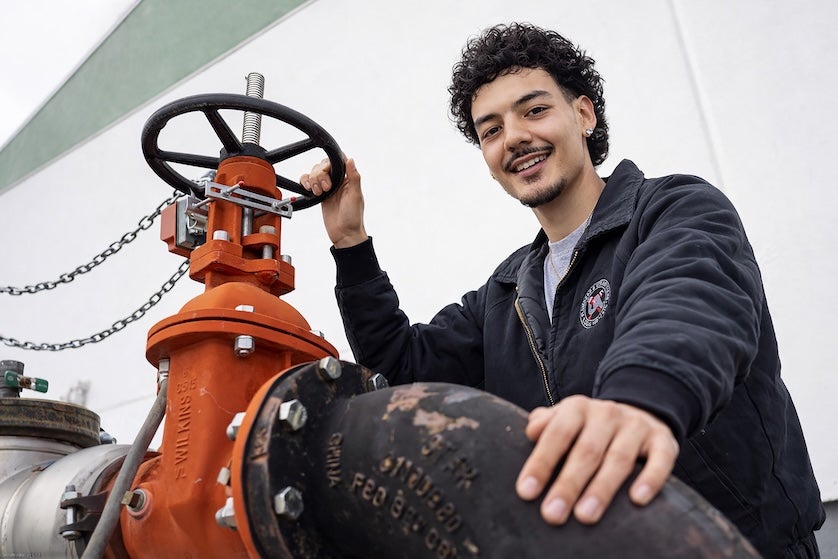
Kai Rush stood at a crossroads. He had enrolled at DVC as a computer science major but soon realized his interest in coding had vanished, leaving him feeling like higher education simply wasn’t right for him.
While Rush loved creating music, he initially didn’t see a viable way to turn that passion into a paycheck. However, taking a leap of faith to enroll in DVC’s music-related courses changed everything. “I was awestruck by the quality of the courses and top-of-the-line equipment that students could access for free,” he says.
Once he immersed himself in music industry studies and audiovisual (AV) technology courses, his motivation returned. Today, Rush studies Professional Music at the prestigious Berklee College of Music, focusing on music business and performance.
He credits his community college roots for giving him a distinct advantage over his current peers, noting that the hands-on training he received at DVC provided him with a deeper real-world education than many students starting out at top-tier universities.
Powering Job-Ready Skills
According to Dr. Nick Vasallo, Program Lead for Music Industry Studies and Co-Chair of Music, the DVC Audiovisual Technology certificate was specifically designed as a highly technical addition to the curriculum to give students job-ready skills that translate immediately into employment.
Students in the program gain comprehensive experience configuring and operating:
- Professional microphones and audio systems
- High-definition video screens and projectors
- Recording equipment and advanced mixing boards
These technical skills power everything from concerts and sports events to corporate presentations and news conferences. By blending students’ artistic passion with rigorous technical instruction, the program fast-tracks them into high-demand careers.
An Industry in High Demand
The curriculum also prepares students to pass the AVIXA Certified Technology Specialist (CTS) Exam. Earning this industry-recognized credential proves a student’s mastery of modern AV systems, significantly expanding their professional opportunities.
Dr. Vasallo sees the program’s connection to real-world employment as one of its greatest strengths. “The AV industry is booming, with strong demand for technicians in live performance, corporate events, hospitality, broadcasting, and multimedia production,” he says.
Because employers need skilled talent so urgently, AV technology students are frequently recruited for internships and job opportunities even before they cross the graduation stage.
From Classroom Training to Professional Experience
While at DVC, Rush sharpened his skills as a stagehand and A2 engineer for campus productions, while also supporting a series of professional concerts produced by GFI Entertainment.
That baseline experience paid off when he transferred to earn his bachelor’s degree. He was able to secure a coveted role as the mix engineer for Berklee Presents solely based on the skills and experience he gained at DVC. Today, he runs recording sessions for backing tracks and works behind the mixing board for the show’s main vocalists and backing band.
Building Connections and Careers
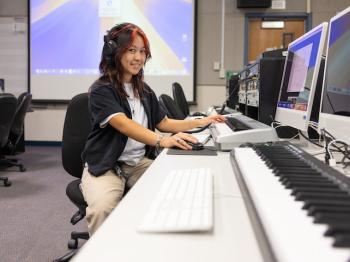
Like Rush, Kriss Limbag views DVC as an outstanding launchpad. She began her journey as a dual enrollment student during her senior year of high school. Now, she is completing an Associate in Science in Audio Visual Technology alongside a Certificate of Achievement in Film Production.
Through the robust professional network she built on campus, Limbag unlocked numerous paid and volunteer opportunities. She found that her visibility while working on campus events allowed faculty and peers to witness her technical skills firsthand, leading to a steady stream of word-of-mouth job offers.
For Limbag, the sheer variety of the field is what makes it exciting.
“AV technicians get to play around with a lot of buttons and knobs. It’s hands-on, and a lot of fun,” Limbag says. “You can go from taping wires backstage for a band to making sure the sound is right in a courtroom. It’s just about everywhere you go.
Rush encourages anyone with a passion for music, audio, or video technology to take their first step at DVC, calling the program an unexpected community college goldmine.
“You’ll have absolutely everything you’ll need for the coolest career you could think of!”
To learn more, visit Music Industry Studies.
Bay Area Salaries and High-Volume Earning Potential
Whether building a steady career with a single production company or charting your own path through freelance project work, the specialized skills learned at DVC hold significant value. Audiovisual technology professionals can pursue careers in sound engineering, broadcasting, AV installation, production management, and live event technology.
Here is a look at the average annual earning potential for audiovisual and music industry roles in the San Francisco Bay Area:
Job Title | Bay Area Average Salary |
|---|---|
Agents / Business Managers of Artists & Performers | $107,370 |
Audio and Video Technicians | $78,480 |
Audiovisual Equipment Installers | $72,110 |
Broadcast Technicians | $77,660 |
Music producers | $92,930 |
Sound Engineering Technicians | $98,220 |
Source: O*NET Online, U.S. Department of Labor
Frequently Asked Questions
What is Audiovisual Technology?
Audiovisual technology involves the use of audio, video, lighting, recording, and presentation systems for live events, broadcasting, entertainment, education, and corporate communications.
What do Audiovisual Technicians do?
Audiovisual technicians install, operate, troubleshoot, and maintain audio and video systems used at concerts, conferences, sporting events, theatrical productions, and other live events.
What Skills do Students Learn in DVC's Audiovisual Technology Program?
Students gain hands-on experience with professional microphones, audio systems, video displays, projectors, recording equipment, and digital mixing consoles used throughout the AV industry.
What is the AVIXA Certified Technology Specialist (CTS) Certification?
The CTS certification is an industry-recognized credential that demonstrates knowledge of audiovisual systems, installation, operation, and support. DVC's program helps prepare students for the exam.
What Careers can Students Pursue with Audiovisual Technology Training?
Graduates may pursue careers as audiovisual technicians, sound engineering technicians, broadcast technicians, audiovisual equipment installers, music producers, and other media production professionals.
Is There Demand for Audiovisual Technology Professionals?
Yes. The AV industry supports careers in live entertainment, corporate events, hospitality, broadcasting, education, and multimedia production, creating strong demand for skilled technicians.