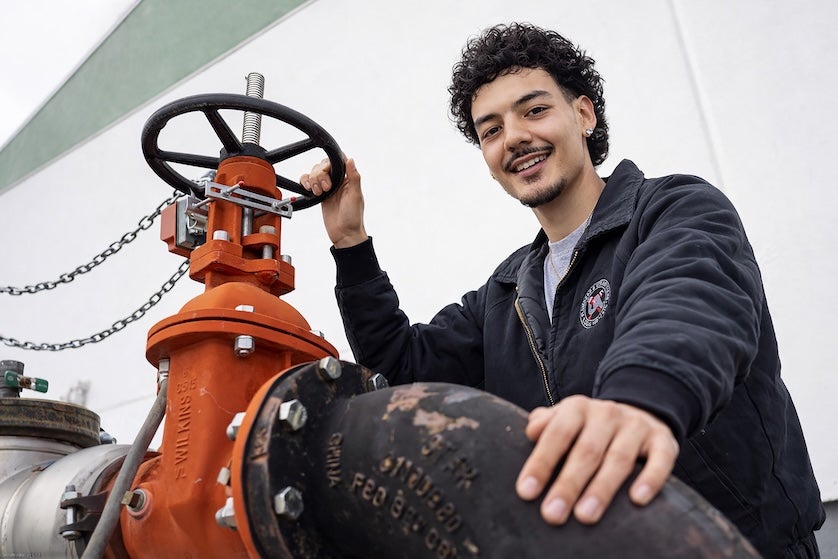
Joey Dalto spent three years at DVC, hopping between majors before realizing the university transfer path wasn't for him. Feeling deflated and struggling academically, Dalto met with an academic counselor to weigh his options.
"I’d previously thought a bachelor's degree was the only way to build a good career. The counselor suggested I look into the Pre-Apprenticeship program to learn about careers in the trades," Dalto says.
Preparing for Skilled Trades Careers with the DVC Pre-Apprenticeship Program
The DVC pre-apprenticeship program introduces students to skilled trade careers that offer high wages, union benefits and long-term stability. It acts as an eye-opener for students who might not realize the breadth of opportunities available to them.
"Students can't choose the best path for them if they don't know all their options, and that's exactly what this program helps them figure out. Because students don’t know what they don’t know," says Shawn Kammerer, construction faculty lead and pre-apprenticeship program coordinator at DVC.
According to Kammerer, the program's broader goal is to guide students through career exploration, help them find the right fit, and support them through the competitive union application process.
This exposure is precisely what attracts students like Alfonso Carrillo Gonzalez. Introduced to the trades by his brother, Gonzalez enrolled to explore his options and quickly realized how vast the industry truly is. “I’ve learned about trades I had never heard about before,” Gonzalez says, noting that he now plans to pursue a career in heating, ventilation and air conditioning (HVAC) or possibly plumbing.
Pre-Apprenticeship vs. Internship: What’s the Difference?
While the pre-apprenticeship program and internships both offer hands-on, real-world experience, they serve different training goals:
Internships enable students to gain valuable work experience at a specific job site. In most cases, internships are short-term, lasting for a summer or a single academic term, where interns receive course credit and sometimes an hourly wage.
The pre-apprenticeship program is a specialized training pipeline leading to a well-paying multi-year apprenticeship through a local union. Students learn both in the classroom and on active job sites, developing the precise knowledge and skills required to pass highly competitive union entrance exams.
Pre-Apprenticeship Certificate Requirements and Coursework
The pre-apprenticeship program enables students to enroll and complete a certificate quickly. Full-time students can earn a Certificate of Achievement in just one semester, while part-time students can split the coursework over two terms. Alternatively, students can choose a shorter three-class commitment to earn a Certificate of Accomplishment.
Certificate of Achievement, Pre-Apprenticeship (18.5 units)
- CARER140 - Job Search Strategies (1 unit)
- CONST105 - Survey of the Trades (1.5 units)
- CONST110 - Occupational Safety (2 units)
- CONST114 - Print Reading (3 units)
- CONST135 - Construction Processes: Residential (4 units)
- CONST215 - Construction Job Site Training (2 units)
- KNACT120 - Physical Fitness (1 unit)
- MATH092 - Math for Trade Pre-Apprentices (4 units)
Certificate of Accomplishment, Pre-Apprenticeship (8 to 9 units)
- CONST110 - Occupational Safety (2 units)
- CONST114 - Print Reading (3 units)
Choose one:
- MATH092 - Math for Trade Pre-Apprentices (4 units)
- MATH121 - Plane Trigonometry (3 units)
Hard Hats and Hands-on Experience
For Dalto, the program provided an all-access pass to the industry, offering opportunities to tour union halls and network with representatives and coordinators, connections he says he never would have pursued on his own.
The curriculum extends far beyond traditional classroom settings, providing a realistic preview of the industry. "We prepare students for the realities of working in the trades by throwing them onto active Habitat for Humanity job sites, letting them get their hands and their clothes dirty," Kammerer says.
Dalto believes this first-hand exposure is essential for anyone curious about the field, given the scope of the commitment. "Committing to a union apprenticeship is more significant than starting a new job because it’s a multi-year program. So, it’s important to be certain that this is the career you want, and that this is the way you want to do it."
A Solid Framework
Haris Faiez already had a solid background in construction when he moved to California, having worked on canal projects and residential building systems in Afghanistan. Even so, restarting his career in a completely new place wasn't easy.
“I had to adjust to a new country, a new education system, and a new professional environment,” says Faiez.
Knowing he needed to take things step-by-step, Faiez enrolled in the DVC pre-apprenticeship program to make industry connections as well as develop a better understanding of the United States construction industry. The hands-on nature of the program gave him a clear sense of exactly what local employers and unions expect from applicants. He was surprised to see just how many different paths he could take within the trades and was excited to find a route to a stable career.
Faiez ultimately decided to focus on carpentry. Noting that in Afghanistan, residential buildings are typically built with stone foundations and brick walls, he enjoyed learning about lumber framing. Now, he looks forward to a career that lets him combine that technical knowledge with hands-on work.
After completing the pre-apprenticeship program, Faiez chose to continue his education, and is pursuing an associate in science in construction management. He also looks forward to joining the carpenters union.
“The DVC pre-apprenticeship program has been an important part of my journey, giving me direction, support and a real opportunity to build a better future,” says Faiez.
Finding the Right Fit
Matthew Rendon Ibarra always had an interest in construction but lacked a clear direction. After high school, he worked at Lowe’s while taking general education classes, initially eyeing a major in construction management before discovering the Pre-Apprenticeship program.
"Like many students joining the program, I had no idea what I wanted to do. I just knew I wanted to be in a union," Rendon Ibarra says.
To help students find their footing, the program uses a "cohort” model, where students move through their classes together as a group. For Rendon Ibarra, this structure quickly turned classmates into close colleagues, building a sense of community that made him genuinely look forward to coming to class every day.
A Competitive Edge
Rendon Ibarra credits the program for giving him a head start on the rigorous union application process. "The math class helped me pass the union entrance exam, and the Occupational Safety class enabled me to obtain my Occupational Safety and Health Administration (OSHA) 30 card before my union interview," he says.
Both Dalto and Rendon Ibarra have earned their Certificates of Achievement and now serve as apprentices with the Plumbers & Steamfitters, UA Local 159 in Martinez. Gonzalez plans to follow in their footsteps. Upon completion of their five-year apprenticeships, they will earn an associate in applied sciences through the union’s partnership with DVC.
"This program is a great launchpad. It gives you an advantage and makes you more competitive. It prepares you for real job opportunities and builds connections with unions, making it easier to get accepted into an apprenticeship," Rendon Ibarra says.
To learn more, visit Pre-Apprenticeship
Discover your Trade
The DVC Pre-Apprenticeship program prepares students to begin an apprenticeship with a local union. Skilled trade career options explored in the program include:
Job Title | Bay Area Average Salary |
|---|---|
Brickmason | $76,340 |
Cabinetmaker | $57,600 |
Carpenter | $80,950 |
Cement Mason | $76,650 |
Electrician | $93,750 |
HVAC Installer | $76,760 |
Iron Worker | $82,020 |
Painter | $61,910 |
Plasterer | $71,330 |
Plumber/Pipefitter | $71,700 |
Sheet Metal Worker | $98,140 |
Welder | $63,890 |